The Importance of Well Stocked Backup Supplies
Tips to Help Students Struggling with Multiplication
Every year I have a few students who struggle with multiplication, be it remembering their multiplication facts or understanding how multiply larger numbers, and it's not just a 6th grade problem. I once had a jr high teacher storm my room demanding to see our math book for proof my previous class had covered multiplication, and another jr high math teacher declared to her class I must have skipped that chapter (they were totally kidding and the kids totally didn't get it... SO MANY parent phone calls that night...).
This past year I got a crash course in multiplication intervention thanks to a sweet young man who started our first math lesson off by SHRIEKING "I won't do it!!! I WON'T!!" as soon as he saw multiplication problems on the board. Over the next few days I learned "won't" meant "didn't know how to" and had bad experienced heaped on bad experience that we were going to have to wade through.
He wasn't the first. I doubt he'll be the last, and I'm not entirely convinced he'll remember any of what he learned when he walks through the door of his 7th grade math class next year.
1. Reteach: I always start the year with a whole class lesson reteaching the "standard multiplication algorithm." This is a great way for me to assess where students are at with multiplication so I can adjust instruction from there. I do a repeat of lesson the following day and provide scaffolded algorithm worksheets to those that struggled the previous day. Sometimes that's all it takes, by the time we move onto decimal multiplication on day 3 they're sailing right along. However, sometimes they need more.
2. Reset: The "dream catcher method" has been my go to reset method since I first started teaching 6th grade. Also called lattice or the Japanese Method, it focuses on the basic facts and looks nothing like the standard format, which can be the most important thing for a struggling student. Below is a video going over it in more detail.
3. Review: Multiplication facts are the foundation of more mathematical processes than I care to try to count, so fluency in those facts are critical for mathematical success. Because of this I put a year long focus on multiplication facts and display them in several formats around the room to get as much exposure
as possible. I display the multiplication fact families as posters at the front of my room, which were created by To the Square Inch and can be viewed at this link. I use a math reference sheet including a multiplication chart as the back cover of my student math notebook, which was created by Teaching on Lemon Lane and can be viewed at this link. At the frustration of one of my students I also added a column style multiplication fact family reference sheet to my room this year. I have them printed double sided and stored in a pocket chart at the front of my room. The game Multiplication Squares, which was created by Claire Lambert and can be viewed at this link, is a year round feature in my classroom and students are encouraged to play it a an early finisher activity.
Note: 2 & 3 are interchangeable in my book, and it
4: Refer: If a student is still struggling I refer them to our Title I aide with a daily fluency practice to work on for 9 weeks and reassess. My go to fluency practice is the 36 Weeks of Math Fluency Practice made by Wife Teacher Mommy. I typically have students start with the 4th grade fluency practice, and after completing 5 worksheets in a row at 80% or more they move on to the 5th grade fluency practice. I usually remove them from Title 1 once they've completed 5 5th grade worksheets in a row at 80% or more. These fluency practice sheets are also a great pre-assessment to help determine where students are struggling.
I hope my process for helping students struggling with multiplication will be of use.
Gettting to Know Myself
Building Relationships with Students: Lunch with Teacher
I've seen several posts asking about how to build relationships with students, so I wanted to share some of the things I've done for the past nine years to build relationships with my students.
Lunch with teacher is by far one of the most popular relationship builders I've done with students. Twice a month until I've made it through my entire class I randomly select 5 students to invite to lunch. I set up a time the week before for them to put their heads together and come up with what we're having and then I make it up over the weekend and pick them up after recess to join me for lunch either in our room or at a table in the cafeteria depending on their preference.
Creating Your Own Math Notebook
Over the past 10 years I've created notes for nearly a dozen different math, language arts, and science curricula, and I always start by looking at the structure of the textbook since most follow a consistent formula from lesson to lesson.
In the curriculum my school uses the first page of each lesson is usually an info dump or a think about it type of problem. With the exception of a few lessons this part usually isn't student friendly, leads to a lot of frustration, and has too much consolidated info, so I usually find the majority of the material for my notes on the second and third pages of each lesson in my book.
I try to limit what I put in my notes and spoken lesson to the 2-3 most important sentences from the book's lesson with blanks put in not for the bolded vocabulary words but for the smaller, yet still critical for understanding, words.
I've also noticed that a lot of curriculum give examples of how they want things worked out, and I love using these in my notebooks since I can highlight alternate ways to do the problems, have students compare back to the book, and have the kids use them for hints and answer checks.
I've found that basing my spoken lesson off the notebook I've created for my students helps me to target my instruction and keep each lesson straightforward and easy to understand.
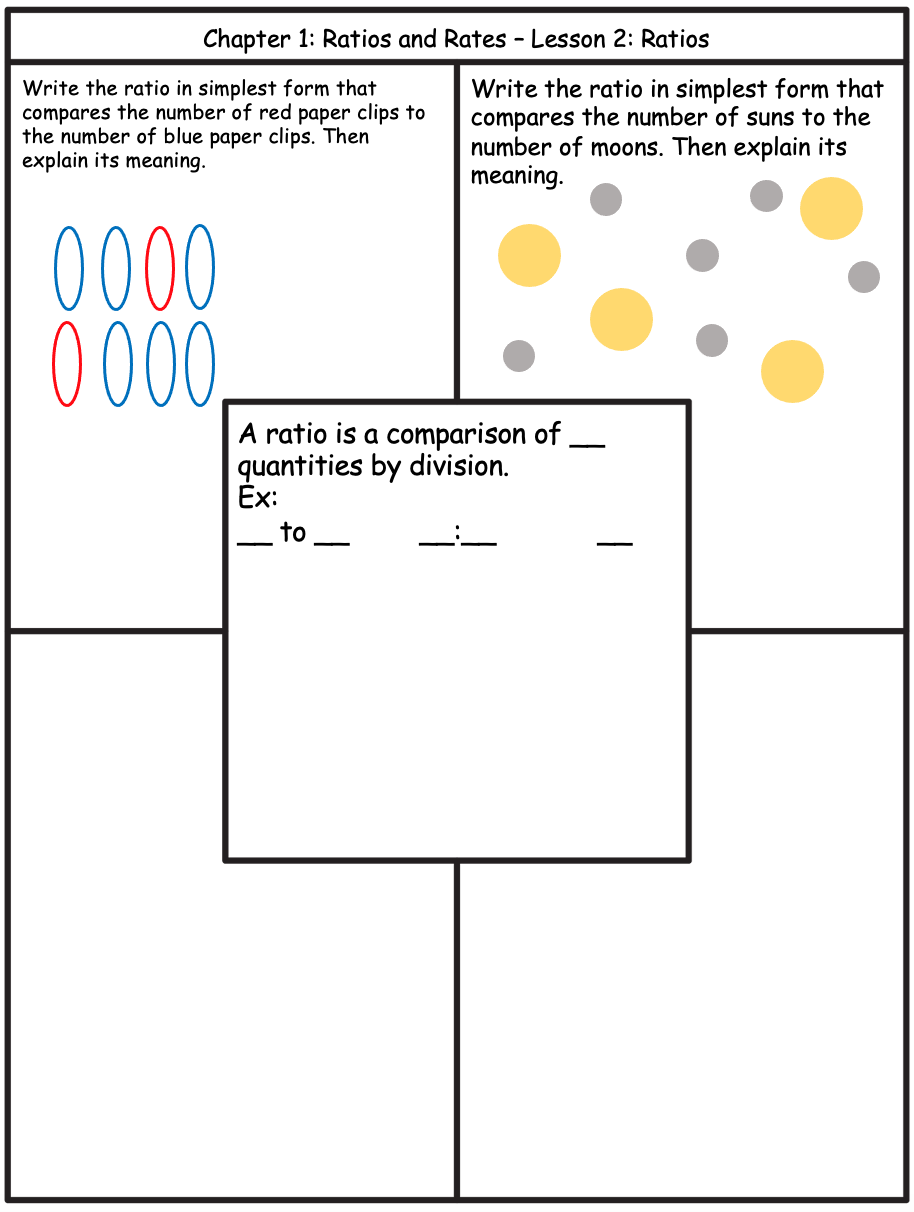
The majority of my lesson and notebook is based off the book's examples with room for the kids to work them out themselves.
Classroom Management that Doesn't Break the Bank Part 1
If you're unsure what I'm talking about, classroom economies are an intensive based type of classroom management system involving fake money that kids can earn and loose money based on behavior, and they can use their money to purchase things within the classroom.
Over the years I've been asked if I feel that I'm bribing my students or teaching them bad habits through monetizing tasks and behaviors instead of relying on intrinsic motivation, and I think the age and perspective of my student is a huge factor in why I feel comfortable using a classroom economy.
I teach 6th grade and my students respond very well to the idea of school as their "job," so getting paid for certain aspects of school (coming to school on time and prepared, being a good roll model to younger students, turning in their homework, and doing their classroom jobs) really resonates with them.
However, there are certain things I won't pay students for like doing their work in class or being respectful to me and other students. They can also get charged a fine (usually $10) if they break our classroom rule of "do nothing to keep others from learning."